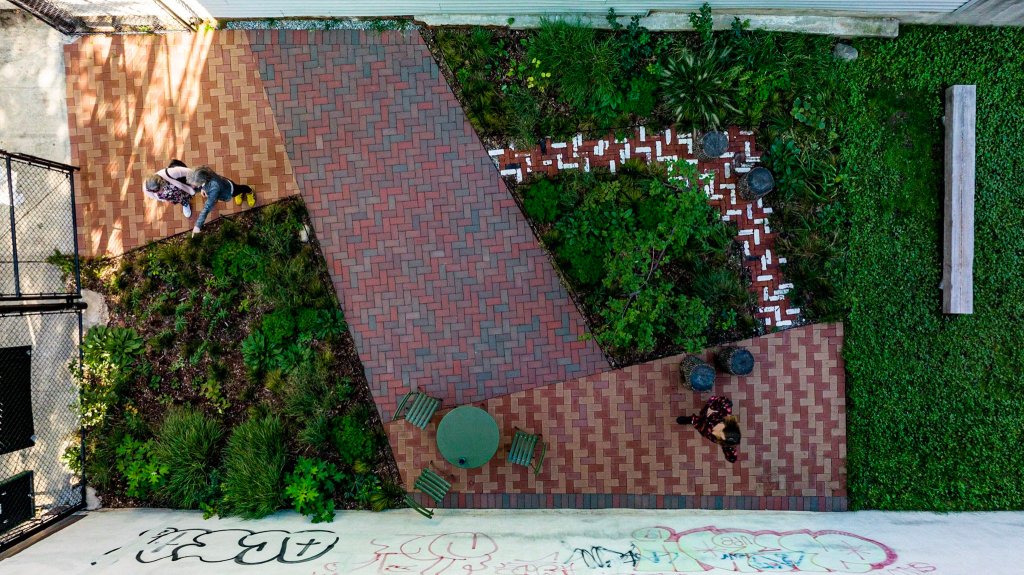
Dolly’s Park is a small community GreenThumb park in Gowanus, Brooklyn. Landscape architects at Assemblage and builders at Field Form worked together with help from block residents to rebuild the park, transforming it from a gravel lot into a more accessible and inviting space. Salvage and reuse played a key role in the project, helping to preserve the neighborhood’s material legacy while reducing embodied carbon emissions and keeping costs down.
A Hyper-Local Approach
The neighborhood of Gowanus is centered on the Gowanus Canal, a former industrial inlet to New York Harbor flanked by factories, depots and warehouses. The canal zone is currently undergoing a rapid transformation into a high-density residential area, and many industrial buildings, some of them over a century old, are being demolished to make way for the new construction.
Assemblage and Field Form are both located in Gowanus on the east side of the canal. Surrounded by demolition sites, they could see valuable building materials being torn down that were bound to be crushed into low-value aggregate or sent to landfill. They decided to try and salvage what they could from these sites and find a new home for them in Dolly’s Park.
From A Roof To A Bench
Just to the west of Dolly’s Park on the same block, real estate investment company AveryHall bought ten adjacent properties occupied by warehouses and demolished them in order to build a new mixed-use development.
Among the warehouses was the South Brooklyn Casket Company, where funeral caskets had been manufactured since the 1930s. As its facade was torn down, revealing the structure inside, Field Form spotted large timbers supporting the roof. The timbers were made from yellow pine from the southeastern US, a wood product that is no longer harvested, and they had ideal cross-sectional dimensions to be used as benches.
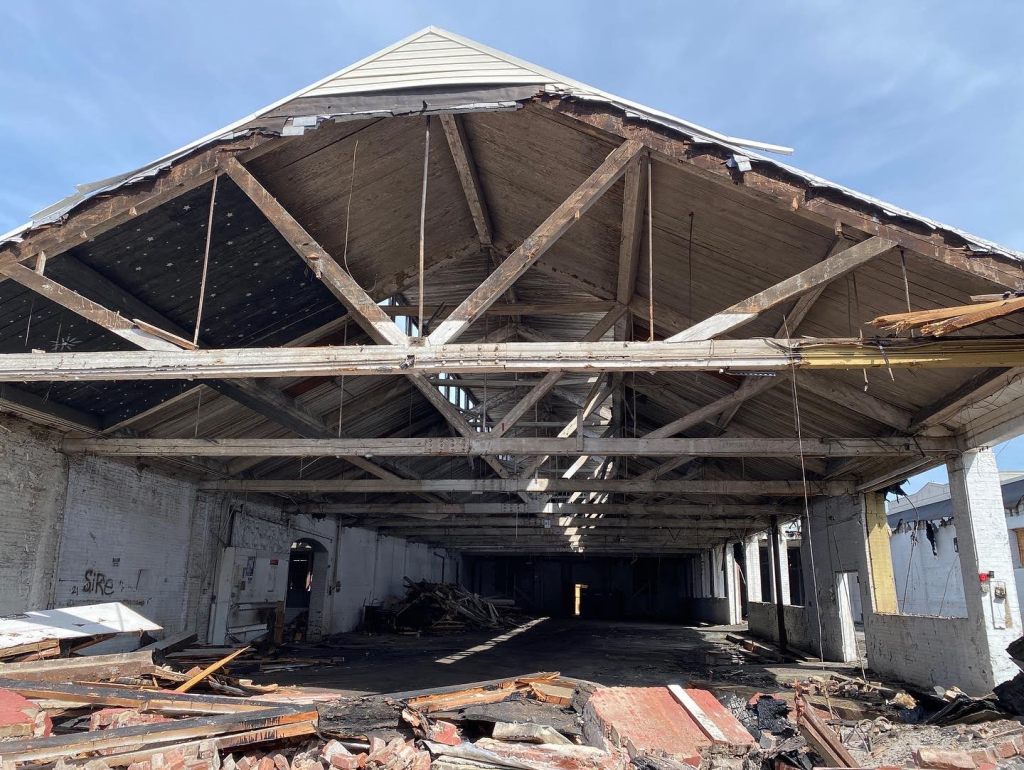
Demolishing the South Brooklyn Casket Company (Photo: Assemblage)
Field Form approached the site superintendent to inquire about the timbers and got permission to take some of them off the site at no cost. (The demolition company then sold the rest to a wood salvage company.)
Field Form hauled the timbers onto the sidewalk outside the demolition site, cut them with a chainsaw to bench length, loaded them one by one onto a dolly cart and wheeled them around the corner to the Dolly’s Park site.
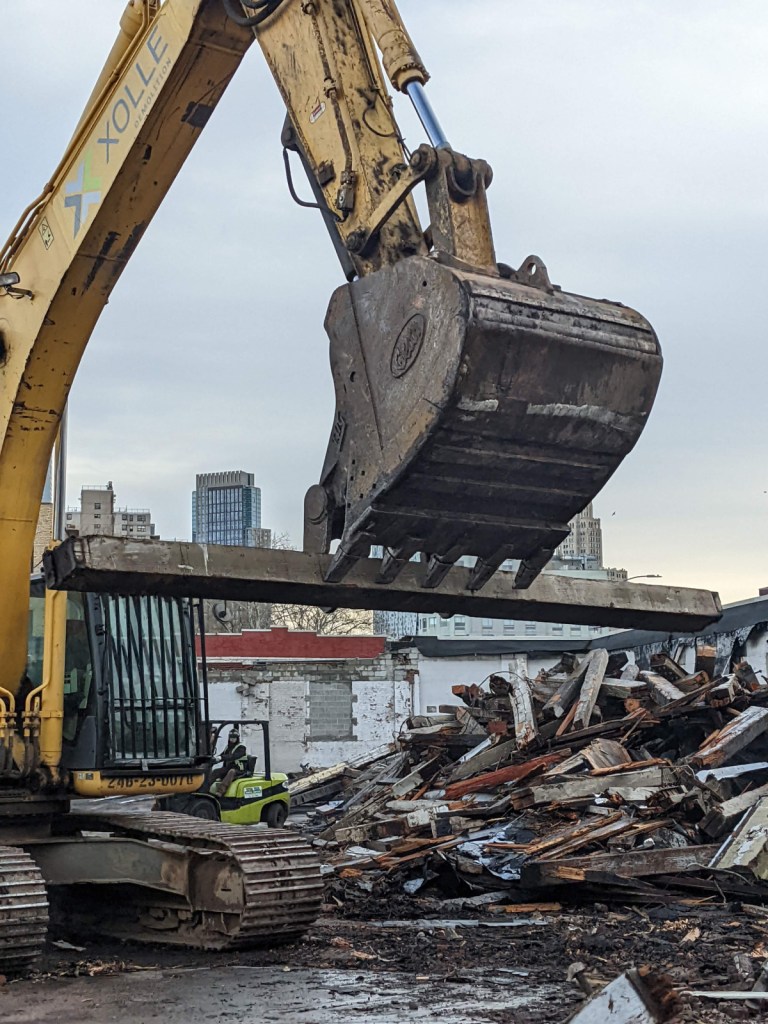
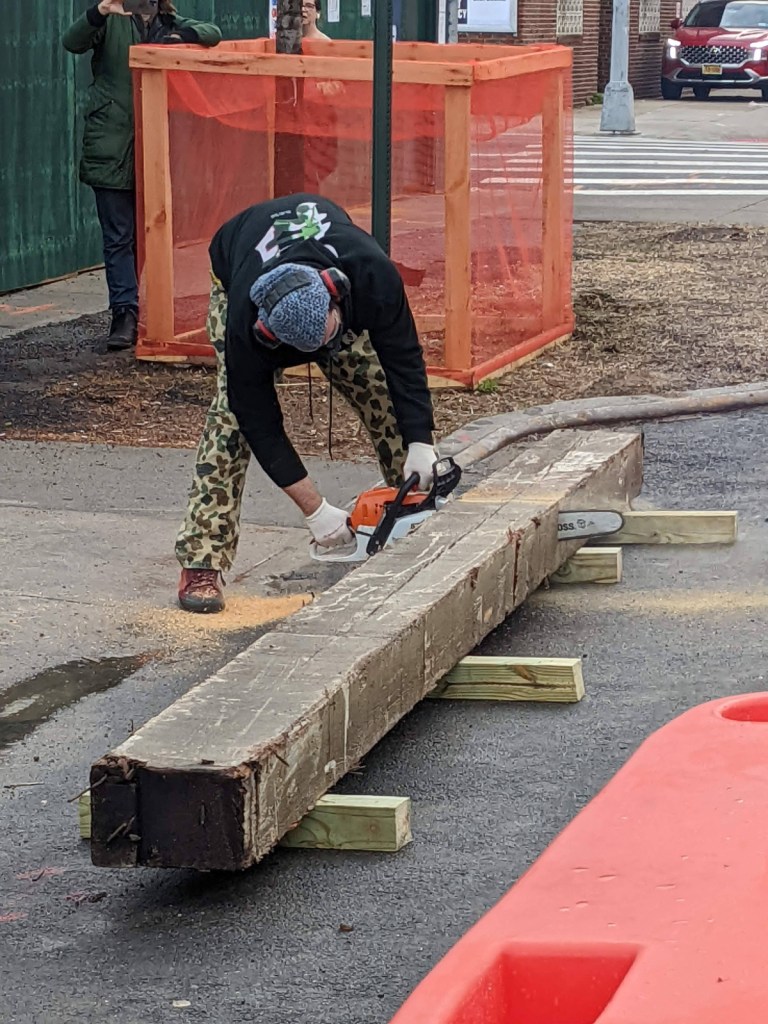
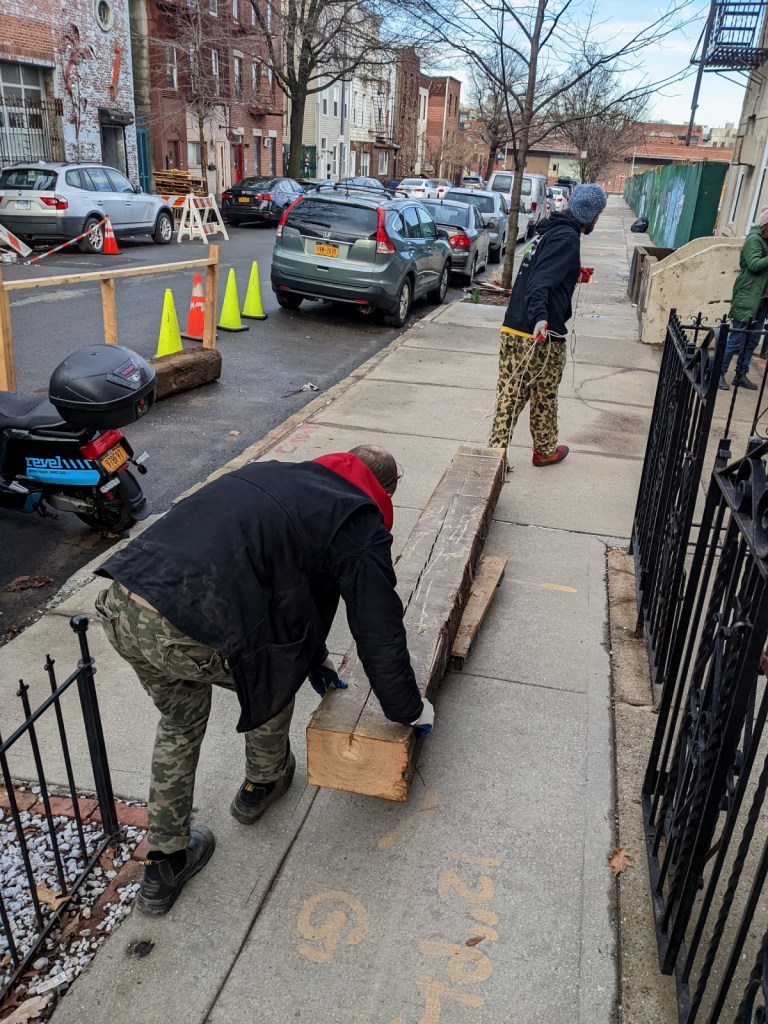
Salvaging timbers from the South Brooklyn Casket Company (Photos: Field Form)
At Dolly’s Park, Field Form refined the rough chainsaw cuts, applied a finishing seal and mounted the timbers to concrete foundations.
Due to variations between the timbers, each of the benches has its own unique character, adding organic texture and variety to the park.
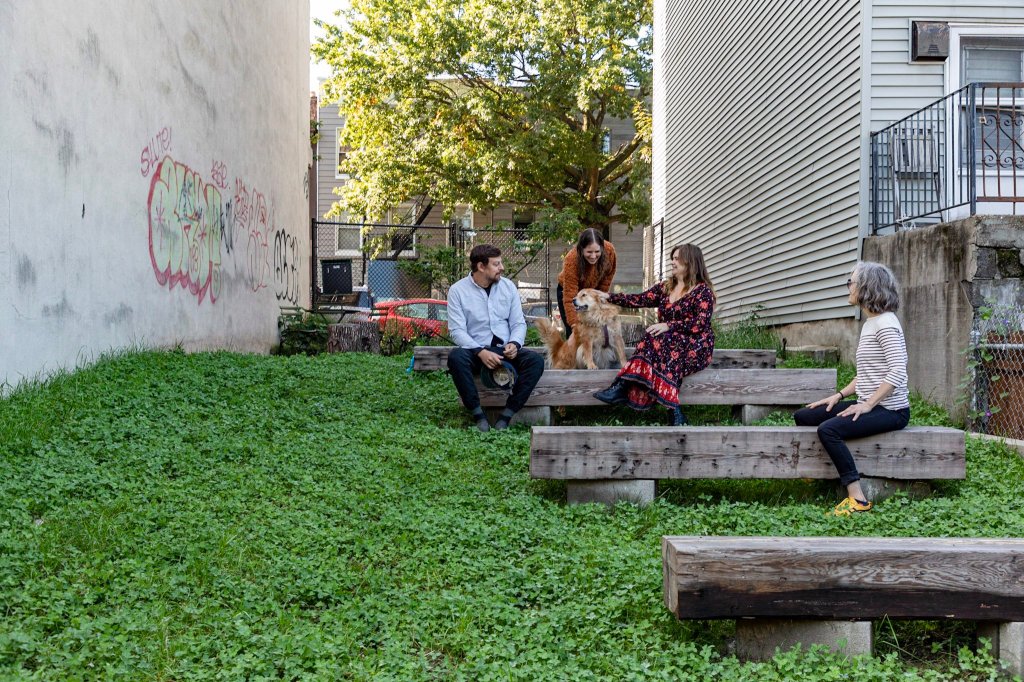
The finished benches (Photo: Barrett Doherty)
From A Wall To A Path
Bricks for the project were salvaged from another building on the block being demolished to make way for the new mixed-use development.
Because the brick walls were hastily torn down using conventional demolition methods, Field Form had to sort through piles of debris consisting mostly of broken brick fragments.
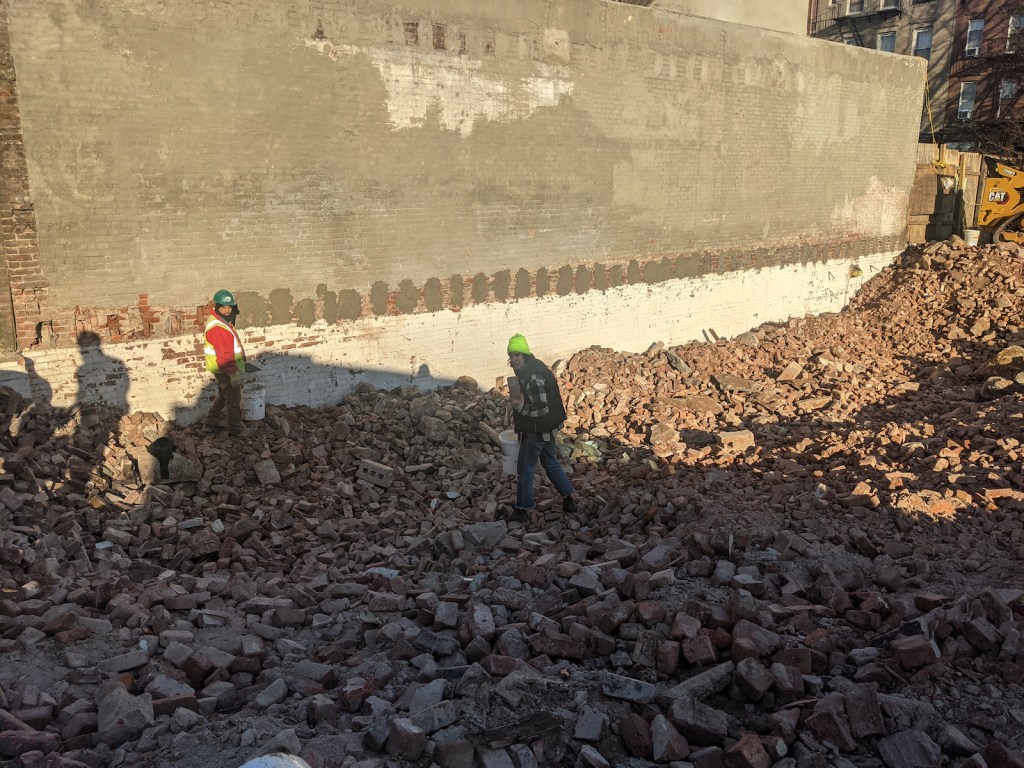
Searching through brick rubble (Photo: Field Form)
When they found surviving whole bricks, Field Form loaded them into five gallon buckets and wheelbarrows and walked them over to Dolly’s Park.
The demolished brick wall had been painted white on the exterior, so all of the salvaged bricks had one white face. Assemblage took advantage of the face variation to create a dynamic pavement pattern, alternating between unglazed and painted sides facing up.

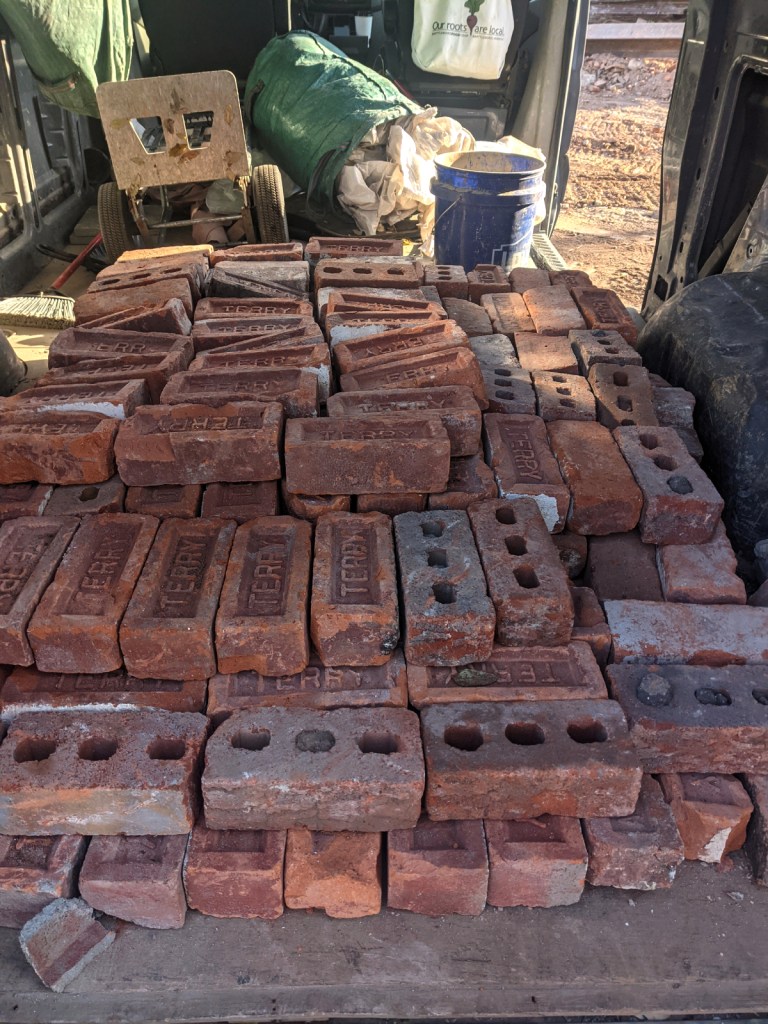
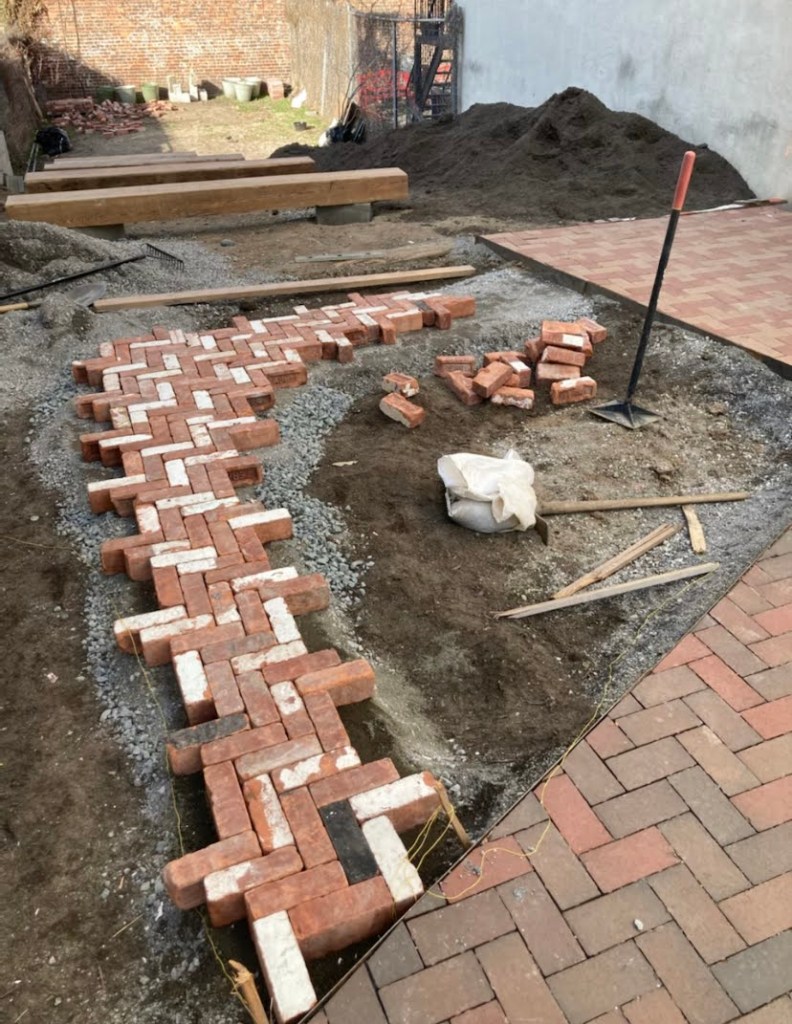
Salvaging, sorting and installing bricks (L and C photos: Field Form / R photo: Assemblage)
The total quantity of salvaged bricks was not enough to cover the entire paved area of the park, so Assemblage sourced additional clay pavers from dead stock at Luisi Building Materials in South Brooklyn. Dead stock refers to products that have been discontinued or are left over in small quantities and are discounted to give them a ‘last chance’ before being sent to landfill. Assemblage took the challenge of different dead stock paver quantities as a creative opportunity, patterning the pavement area into three intimate zones.
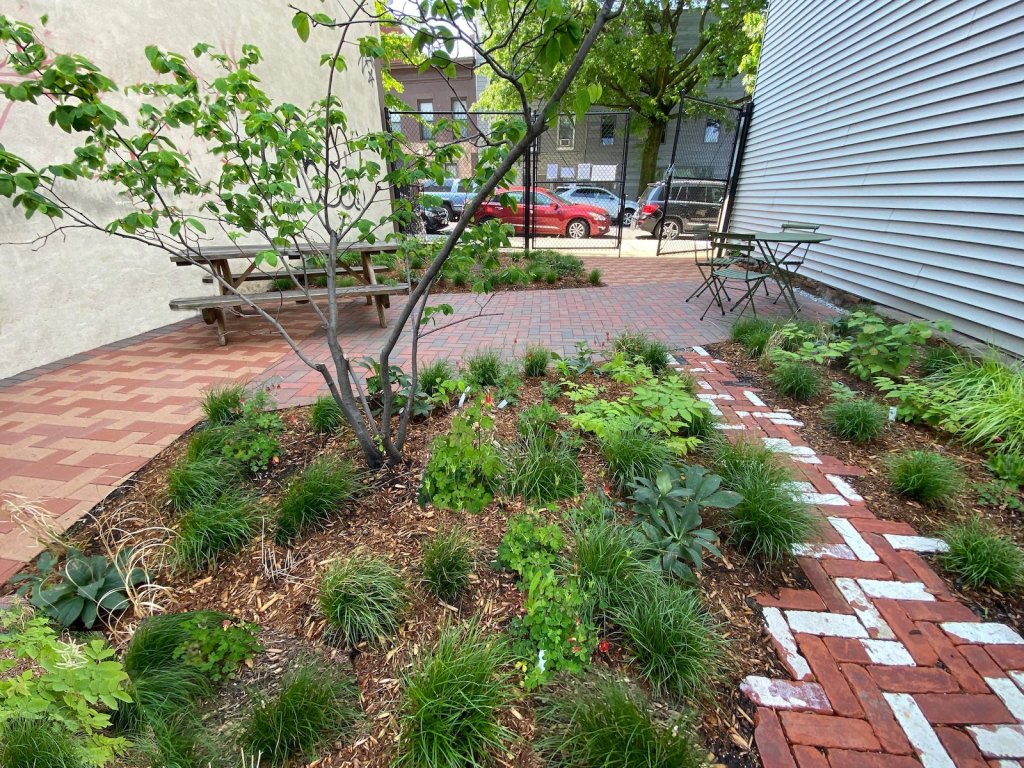
Brick zones (Photo: Barrett Doherty)
The Benefits Of Salvage
Salvaging materials in the neighborhood benefited the Dolly’s Park project in three key ways.
First, it reduced the project’s environmental footprint. Reusing existing materials averts new natural resource extraction and significantly reduces greenhouse gas emissions. Manufacturing new bricks requires firing clay in high-heat kilns powered by fossil fuels as well as transporting them over long distances to the construction site, resulting in high embodied carbon. By comparison, salvaging and reusing bricks in Dolly’s Park required minimal fossil fuel energy to operate the demolition equipment and only required human labor to transport the bricks to the park site.
Second, salvage reduced the cost of materials for the project, helping the team stay within a tight budget. Because minimal material processing was required, the cost of labor was about the same as if new materials had been used.
Finally, recovering materials from the neighborhood has helped to preserve Gowanus’s industrial history and honors the people who made and installed the materials. “There’s something very practical about making it work,” reflects Wendy Andringa, principal at Assemblage, “but there’s also a poetic aspect that shouldn’t be overlooked in respecting the history of labor, of resource extraction, of all the time and resources that go into making materials.”
Challenges For Scaling Up
Dolly’s Park shows that salvage from demolition sites can be successfully integrated into new construction projects in New York City but it also reveals challenges to more widespread adoption. How could these challenges be overcome to scale up salvage and reuse?
Deconstruction over demolition: Conventional demolition methods damage and destroy materials that could retain a higher value, like the bricks turned into rubble at the demolition site near Dolly’s Park. More careful deconstruction methods might have enabled Assemblage to pave the park’s entire hardscape with salvaged bricks. How could careful deconstruction be better incentivized?
Demolition awareness: Assemblage and Field Form could observe demolition sites in their own neighborhood and act fast when a particular material was coming down but didn’t have visibility into sites outside Gowanus. Could demolition timelines be made available to the public well in advance of the work so designers and builders can more easily locate materials for salvage? Could the timelines be listed in an online database?
Liability: Gaining access to a third-party demolition site to collect materials raises questions about liability. How can risks to both the demolishing party and the salvaging party be mitigated, especially when there is no prior contract and a limited time window to transfer the materials?
If you have ideas for how we can address these challenges in New York City, please join us at our next Reclaim NYC meetup!
Reclaimed Materials List
Brick: 50 ft2 salvaged from local demolition site
Timbers: 32 linear ft salvaged from local demolition site
Recycled Concrete Aggregate: 200 ft3 from NYC Department of Transportation RCA Bank
Trees: 2 trees from Gowanus Canal Conservancy
Tree Stumps: NYC Parks Department
Further reading
Project Information
Location: 503 President St, Brooklyn, NY
Year Completed: 2022
Project Area: 2,000 sqft
Typology: Park
Project Scope: Rebuild of an existing park
Reclaimed Materials: Brick, Wood timbers, Recycled concrete aggregate, Trees, Tree Stumps
Project Team:
Landscape Architect: Assemblage
Builders: Field Form
Reuse Partners:
Trees provided by Gowanus Canal Conservancy
Recycled Concrete Aggregate (RCA) supplied by NYC Department of Transportation
t
er
 RECLAIM NYC